In recent years, the topic of sustainability has become central in public debate and in the business world. It is discussed more and more, but today declaring that a product or service is “sustainable” is no longer sufficient: the market requires tools capable of demonstrating it in a clear, objective and verifiable way. In this context, certifications represent one of the most effective tools for translating sustainability principles into concrete and measurable parameters. Through recognized standards and independent verification procedures, it is possible to transparently analyze the characteristics of a product along its life cycle, offering operators and customers reliable data on which to base their choices.
In this context, elements such as mobile homes are taking on an increasingly important role in the design and offering of camping villages. Having certifications means not only strengthening the credibility of one’s offer in environmental terms, but also equipping oneself with useful tools to participate in tenders, access incentives and benefit from advantages that increasingly reward investments oriented toward sustainability, such as the Nuova Sabatini Green, which provides a state contribution on the interest of financing intended for the purchase of new machinery, plants and equipment that support ecological transition and energy efficiency of production processes.
A significant example comes from the collaboration between Crippaconcept, a company specialized in the design and production of mobile housing units for campsites and tourist villages, and the Villaggio Turistico Internazionale of Bibione, a reference reality in the European open-air tourism landscape.
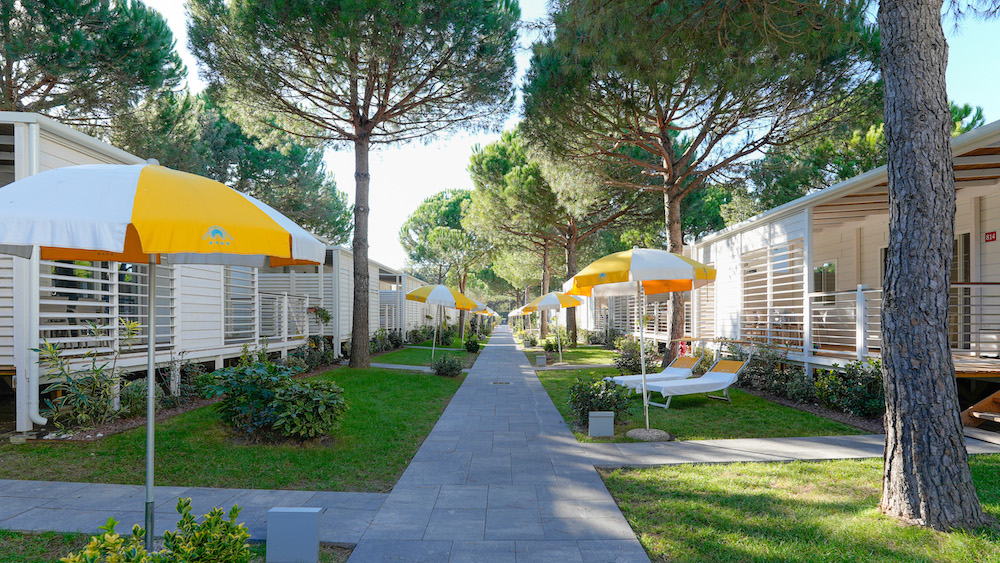
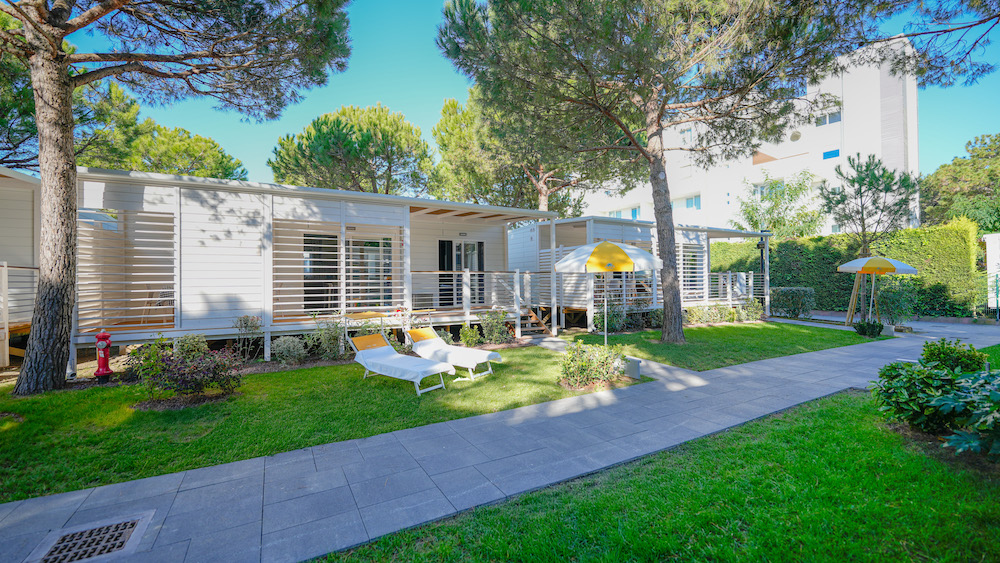
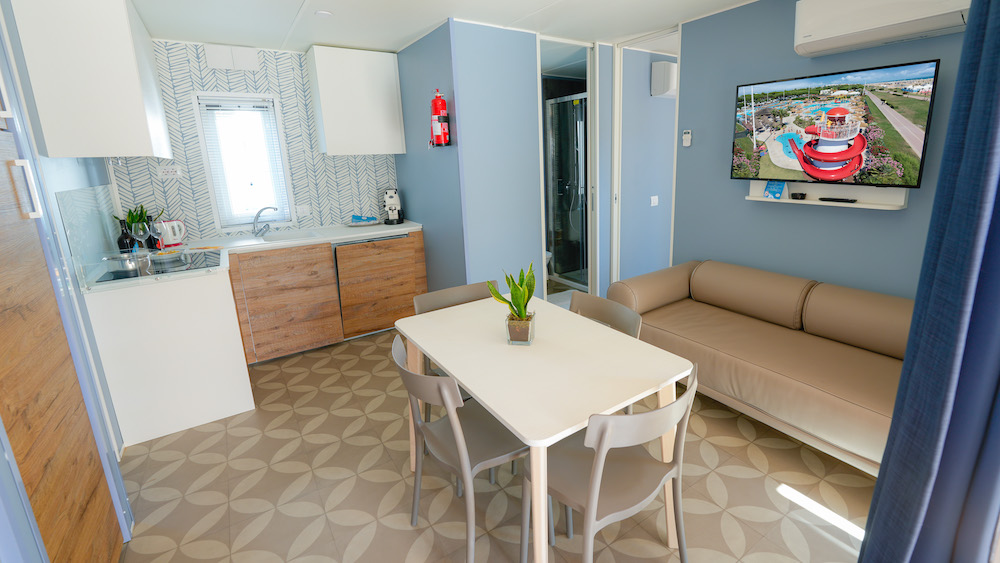
Two Crippaconcept mobile homes subject to certification
There are two types of Crippaconcept mobile homes installed at the Villaggio Turistico Internazionale of Bibione that have been subject to an Environmental Product Declaration (EPD) verified by ICMQ. The publication of the declaration on EPDItaly will take place following the conclusion of the accreditation extension process with Accredia for this product category.
These are the NX-24-119 and NX-24-120 models that share construction and functional characteristics and are designed to accommodate from five to seven people, differing in size and internal layout, with the aim of offering a high-level stay experience, in line with the growing glamping positioning of open-air tourism.
One of the distinctive elements of mobile homes in general, and more specifically of these two models, is precisely the attention to sustainability. The load-bearing structure in fact integrates large components in wood, a renewable material that contributes to reducing the environmental footprint of the product. Moreover, the mobile homes are built on chassis with wheels and do not require permanent foundations, a choice that limits the impact on the soil and allows the reversibility of the intervention with the restoration of the area. The predominantly dry construction system finally facilitates maintenance, disassembly and recovery of materials at end of life.
Precisely to enhance these design choices, the Environmental Product Declaration (EPD), drawn up in compliance with the Regulation (rev. 6.0) of the Programme Operator EPDItaly and the Product Category Rules dedicated to mobile homes, is based on a Life Cycle Assessment (LCA) study, an internationally recognized methodology that analyzes environmental impacts along the entire life cycle: from the production of raw materials to the use phase up to end of life, including transport, energy and water consumption and material recovery.
According to Sergio Redaelli, Chief Executive Officer of Crippaconcept, the start of this process represents a strategic step for the sector:
“In recent years the topic of sustainability has become increasingly central both in design processes and in commercial ones. With the EPD verification we wanted to measure in an objective way the environmental impact of our mobile homes along their entire life cycle, using methodologies recognized and validated by an independent third-party body.”
Data as a concrete tool for communication and access to public tenders and incentives
The LCA study, carried out by Architect Michele Paleari, LCA and EPD expert, adopted as functional unit 1 m² of gross surface area over a reference period of 20 years. With reference to the production phase (modules A1–A3), the analysis highlighted a Global Warming Potential equal to approximately 779 kg CO₂eq/m² for the NX-24-119 model and 742 kg CO₂eq/m² for the NX-24-120 model. For the use phase, on the other hand, operational energy and water consumption (modules B6 and B7) were considered, assuming for each unit: 5.45 kWh/day of electrical energy and 467 liters/day of potable water for 180 days of annual use and a service life of 20 years.
For sector operators, this data represents a concrete tool. “For our customers it means being able to rely on certified and comparable environmental information,” underlines Redaelli. “Environmental transparency thus becomes a structural element of the production process and also a useful tool in communication towards guests and in access to incentive instruments such as the Nuova Sabatini Green.”
The project directly involved the Villaggio Turistico Internazionale, which for years has been carrying forward a structured sustainability process. “Our path originates from a choice of consistency,” explains Chief Executive Officer Alberto Granzotto. “For over twenty years we have been working with certified systems such as ISO 14001 and EMAS, more recently with GSTC, and since 2023 we have also been publishing a sustainability report. The next step was to go into the detail of the product that hosts our guests: the mobile homes.”
The choice to certify our mobile housing units also responds to the evolution of international tourism demand. “Each season we host a growing number of tourists coming from Northern European markets, where environmental sensitivity is now a determining element in the choice of holiday,” continues Granzotto. “Having a verified EPD means being able to demonstrate with certified data the environmental impact of our structures, not simply describe it.”
For Crippaconcept, the first EPD also represents the start of a broader path. “The verification obtained is a starting point, not an end point,” concludes Redaelli. “The objective is to progressively extend the certification to other models. Each EPD is not only a communication tool towards the market, but also an internal driver of innovation: measuring impacts allows us to guide design choices, material selection and optimization of the life cycle of our mobile homes.”
An approach that reflects the evolution of open-air tourism, increasingly oriented towards quality, transparency and sustainability as competitive levers for the future of the sector.