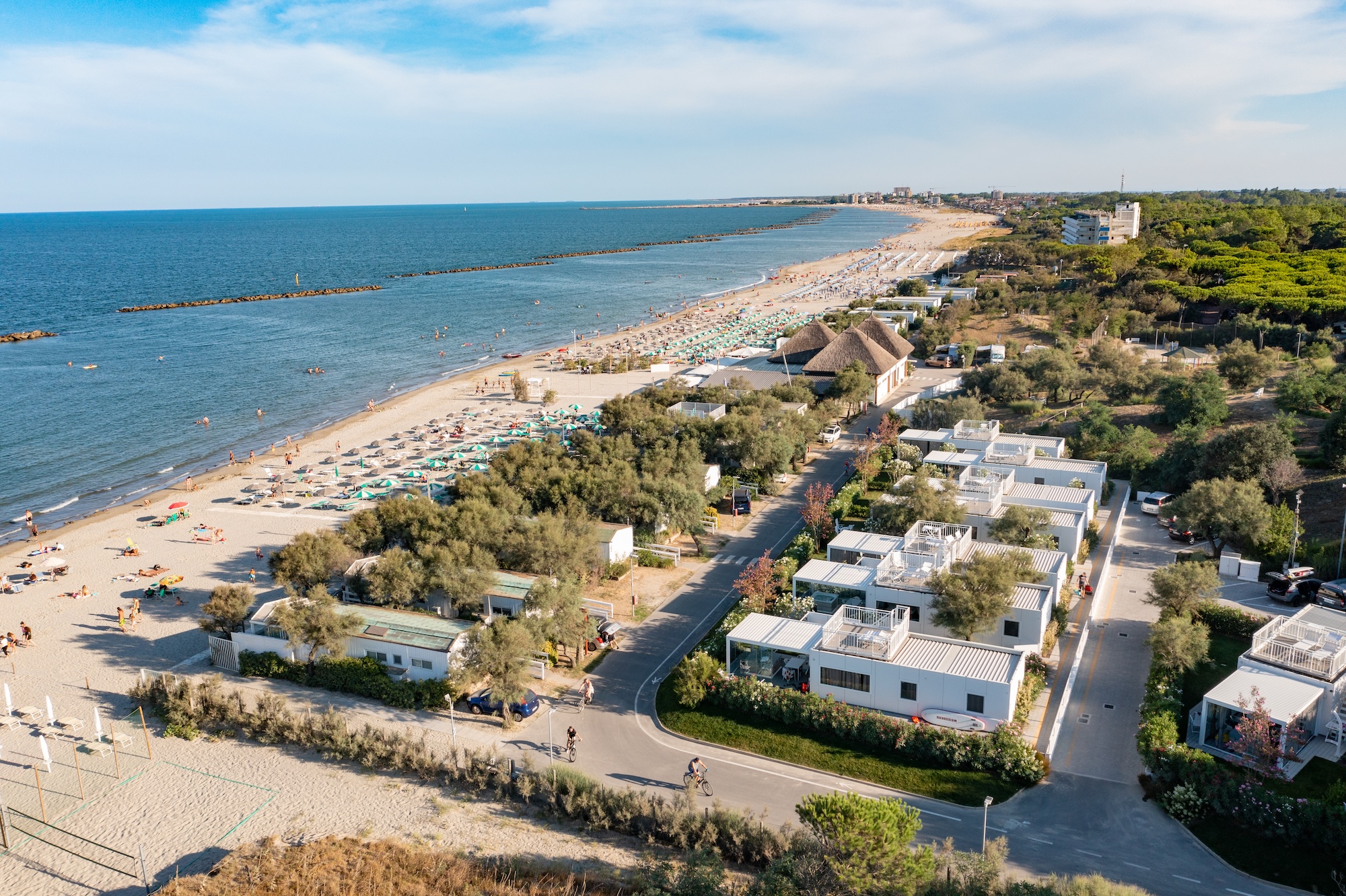
The collaboration between Florenz Open Air Resort and Crippaconcept has been going on for years. It is far more than a simple supplier-client relationship: it is an ongoing dialogue that, season after season, has led to increasingly customised solutions, with a particular focus on accessibility, one of the core values of the campsite in Lido degli Scacchi (Ferrara).
How do you create a project that is not part of a standard catalogue?
“Our collaboration with Crippaconcept is excellent,” explains Barbara Travagli, the campsite’s Marketing Manager, “because it is a solid company with a strong willingness to listen and respond to our specific needs. And that certainly cannot be taken for granted.”
It is precisely this continuous exchange that has led, over the years, to increasingly ambitious projects, particularly in the field of accessibility, which has always been one of Florenz’s key priorities. The resort is recognised at European level for its commitment to inclusive hospitality and, together with Crippaconcept, has developed accommodation specifically designed for guests with mobility impairments, as well as for blind and visually impaired guests.
The latest project probably represents the most advanced stage of this collaboration.
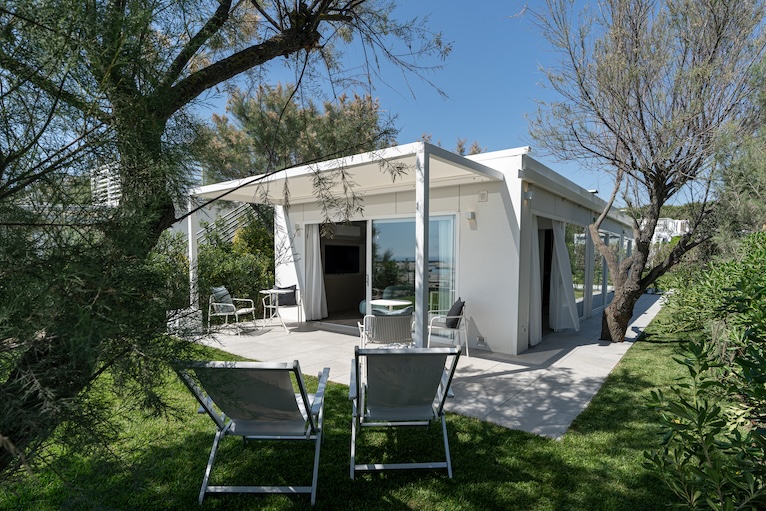
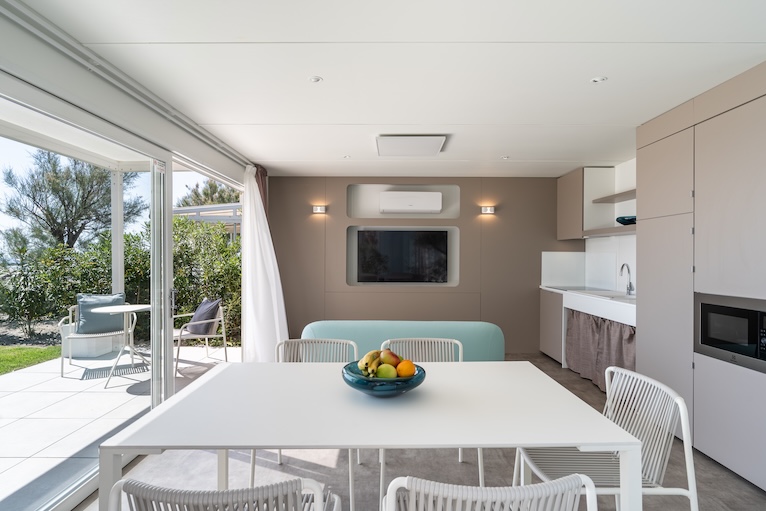
To replace some of the resort’s historic suites overlooking the sea, Florenz and Crippaconcept designed a completely customised type of accommodation. These are not standard mobile homes from a catalogue, but units developed specifically for the campsite.
“Five new units were developed specifically for the Florenz project. The design solution we adopted simplified the installation process while preserving the existing vegetation and ensuring the space required by the resort’s hospitality concept. This allowed us to avoid complicated transportation operations within the campsite and to create much larger living spaces, while keeping the existing vegetation intact,” explains Barbara Travagli.
Behind these new suites lies a substantial amount of design and development work.
From the earliest stages, the Florenz team, supported by Village for All – V4A®, shared with Crippaconcept’s designers all the experience accumulated over more than twenty years of accessible tourism.
Every design decision was made with wheelchair users in mind: from more generous manoeuvring spaces and the arrangement of furniture to the layout of internal circulation routes.
A long-term co-design process
This is not the first time the two organisations have worked side by side on projects dedicated to accessibility. Before the suites for guests with mobility impairments, two types of mobile homes had already been developed for blind and visually impaired guests: a larger suite designed for families and a smaller mobile home intended for couples or solo travellers. The latter was created after observing that most visually impaired guests staying at Florenz travel as a pair.
The process began with a meeting that Barbara Travagli still remembers clearly: an afternoon when Sergio Redaelli, CEO of Crippaconcept, and his team interviewed the campsite staff specifically about accessibility, gathering all the practical needs that had emerged from twenty years of first-hand experience with guests requiring specific assistance.
The discussion brought to light needs that would be difficult to imagine for anyone who does not work with this type of guest on a daily basis. On the other side, the Florenz team found a willingness to listen and, importantly, to translate those needs into real design solutions.
“The best ideas always come from dialogue,” explains Sergio Redaelli, CEO of Crippaconcept. “When a client shares their first-hand experience with us, our job is to translate it into a project that can genuinely improve the guest experience.”
Small details, changes to layouts, new furniture configurations and accessibility solutions thus become an integral part of the design process, helping to create accommodation that is increasingly aligned with the real needs of the people who will use it.
The details that make the difference
When it comes to accessibility for blind and visually impaired guests, for example, the difference lies largely in the details.
The appliances in the dedicated mobile homes have been redesigned with tactile enhancements. An induction hob, for instance, cannot be considered fully usable by a visually impaired person unless it provides voice feedback confirming each command; the same applies to a microwave oven operated via touch controls.
To complete the experience, tactile maps and descriptive guides in Braille and large print provide detailed information about the indoor and outdoor spaces, while a dedicated welcome kit is provided from check-in onwards, including a tactile map of the entire campsite.
The co-design process with Crippaconcept has not been limited to physical and sensory accessibility. It has also evolved to address the growing demand for business tourism at Florenz.
Separate beds instead of a fixed double bed make it possible to accommodate work groups sharing the same unit, while a sliding curtain can divide the living area from the sleeping area. This solution was introduced following direct feedback from guests and was subsequently incorporated by Crippaconcept into new developments.
The collaboration is also continuing on the sustainability front. The latest mobile homes are equipped with systems that automatically switch off the air conditioning when doors or windows are opened, helping to reduce energy consumption in a resort that, despite its solar panels and more than 1,000 square metres of photovoltaic surface, remains a high-energy-demand environment.
This commitment has not gone unnoticed. Over the past few years, Florenz Open Air Resort has received numerous important awards, including the PiNCAMP Camping Award in the ADAC category for demographic change and accessibility.
The recognition has reached well beyond Italy. As Barbara Travagli explains, entire families from Northern Europe and Italy choose Florenz precisely because of the resort’s ability to make a holiday genuinely accessible, from the moment guests arrive at reception right through to enjoying a swim at the beach.
The experience shared by Florenz Open Air Resort and Crippaconcept demonstrates how innovation in open-air hospitality can emerge, above all, from the ability to build an ongoing dialogue between manufacturer, accommodation provider and guests.
When dialogue evolves into a genuine co-design process, and every solution is created in response to real needs, the result is added value for operators and an ever-improving holiday experience for the people who ultimately use the accommodation.